Since we first wrote about the utility-scale solar land investment opportunity, there has been a...
The race to build AI infrastructure has run into the reality of the fact that the power grid can't keep up.
In 2026, corporations and data center operators can't afford to wait years for utility interconnection approvals. Because of this, many are turning to on-site power generation, electricity produced directly at or adjacent to the facility, often called 'behind-the-meter,' as a primary strategy to secure the energy their operations require.
For project managers and corporate decision-makers evaluating data center investments, understanding this shift is essential. On-site generation is no longer a temporary backup plan. It is becoming a permanent pillar of data center power architecture.
Why the Grid Alone Can't Meet Data Center Demand
Here are some numbers that tell the story.
- The U.S. Department of Energy reports that domestic data center electricity consumption could double or triple by 2028, rising from roughly 4.4% of total U.S. electricity use in 2023 to as much as 12%.
- McKinsey projects that total data center power load could reach 153 GW by 2028 — nearly double the 82 GW recorded in 2025.
- Morgan Stanley Research pegs the potential shortfall at 49 GW of available power access against 74 GW of projected U.S. data center demand by 2028.
In the meantime, grid interconnection timelines are stretching. Permitting delays, transmission bottlenecks, and stakeholder opposition mean that new utility-scale power connections can take three to five years or longer to materialize.
In established data center markets like Northern Virginia, where facilities already consume more than a quarter of statewide electricity, available grid capacity is spoken for. For companies building AI-ready campuses at the gigawatt scale, that timeline is unworkable.
The result: a growing number of operators are choosing to bring power generation behind the meter, directly onto the data center campus.
What Behind-the-Meter Generation Looks Like
On-site power generation for data centers is not a single technology. It is a portfolio approach. The most common configurations combine several sources into a coordinated system, often structured as a microgrid. A typical behind-the-meter setup may include:
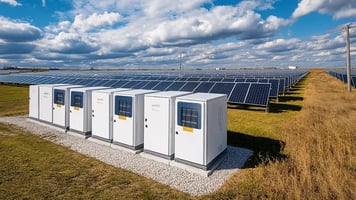
- Solar arrays paired with battery energy storage systems (BESS), providing low-cost daytime generation and stored reserves for evening and overnight hours
- Battery storage acts as a buffer between intermittent renewable output and the constant load profile that AI workloads require
- Natural gas turbines — either aeroderivative units for rapid deployment or combined-cycle plants for long-term baseload — offering reliable, dispatchable power around the clock
- Fuel cells are increasingly favored for their compact footprint and ability to deliver continuous power without combustion emissions
Some operators are also evaluating next-generation technologies such as small modular nuclear reactors, green hydrogen fuel cells, and advanced geothermal as medium-term additions to the onsite generation mix.
While these are not yet widely deployed at data center scale, active pilot programs and investment commitments from major hyperscalers signal growing confidence in their viability.
The specifics vary by geography, utility environment, and project scale. But the guiding principle is consistent: layer multiple generation and storage technologies to deliver high reliability without depending entirely on the public grid.
The Renewable Energy Advantage in Onsite Systems
Solar and wind energy have earned a central role in behind-the-meter data center power for basic economic reasons.
Across most of the United States, solar photovoltaic and onshore wind now offer the lowest levelized cost of energy (LCOE), often undercutting natural gas on a per-megawatt-hour basis.
For corporations financing onsite generation, this cost advantage translates directly into stronger project economics. Solar-plus-storage systems, in particular, offer a compelling combination of attributes:
- Rapid deployment timelines compared to new grid infrastructure or gas plant construction
- Predictable long-term energy costs, insulated from fuel price volatility
- Eligibility for federal investment tax credits and other incentives that improve returns for accredited investors
- Measurable sustainability outcomes that satisfy corporate ESG commitments and stakeholder expectations
Wind generation complements solar by producing power during evening and overnight hours when solar output drops. In regions with strong wind resources, such as Texas, the Great Plains, and parts of the Midwest, hybrid solar-wind configurations can cover a broader share of a facility's load profile.
As U.S. AI data center needs grow, the growing demand for power is drawing increased attention from both operators and investors seeking to participate in the energy transition.
Hybrid Systems and Microgrids: The Operational Standard
The data center industry has moved past the debate over whether to pursue all-renewable or all-fossil-fuel strategies.
The practical answer, validated by major operators and engineering firms alike, is a hybrid approach that layers clean energy with firm, dispatchable generation.
Engineering consultancy Ramboll describes this model as an independent energy network that draws on on-site sources, including natural gas turbines, fuel cells, battery storage, solar, and wind, and gives operators direct control over energy capacity and reliability. These microgrid configurations allow data centers to:
- Island from the public grid during outages or demand spikes, maintaining uninterrupted service
- Optimize generation dispatch in real time, shifting between sources based on cost, carbon intensity, and load requirements
- Scale capacity modularly as the facility grows, adding generation assets without waiting for utility infrastructure upgrades
For project managers, this modularity is a key advantage. A campus can begin operations with a gas turbine and battery storage backbone, then progressively layer in solar and wind as those assets are built and commissioned.
The result is a system that improves its economics and emissions profile over time without ever compromising uptime.
The Financial Case
Behind-the-meter power systems for a large data center campus can represent tens or hundreds of millions of dollars in upfront investment, covering generation equipment, energy storage, site preparation, grid interconnection (if maintaining a partial grid tie), and ongoing operations.
However, the financial case for onsite generation is strengthening. Several factors are working in its favor:
- Avoided costs from grid demand charges, standby tariffs, and transmission fees, which can be substantial for high-load facilities
- Revenue potential from providing grid services such as frequency regulation, demand response, and capacity market participation, through a grid-connected microgrid
- Tax benefits, including the federal Investment Tax Credit (ITC) for solar and storage, which can offset a meaningful share of capital costs
- Long-term energy price certainty reduces exposure to the wholesale power market volatility that grid-dependent facilities face
Battery storage plays a dual financial role in these systems. Beyond smoothing renewable intermittency, storage assets are increasingly valuable as grid services providers.
Utility-scale battery storage is becoming a recognized asset class in its own right, generating returns through both operational savings and market participation.
For corporations and accredited investors evaluating data center energy projects, the combination of tax incentives, avoided utility costs, and long-term price stability can produce risk-adjusted returns that compare favorably with traditional infrastructure investments.
Regulatory and Permitting Considerations
On-site power generation does not exist in a regulatory vacuum. Project managers should be aware of several evolving policy dimensions that can affect project viability and timeline:
- Federal regulators (FERC) generally do not have jurisdiction over behind-the-meter generation that does not interconnect with the public grid, which can simplify approvals for fully islanded microgrids
- State-level utility commissions are increasingly scrutinizing behind-the-meter arrangements, particularly where they may shift grid maintenance costs onto other ratepayers
- Environmental permitting for gas-fired generation varies significantly by state and locality, and emissions requirements can influence technology selection
- Interconnection agreements for hybrid systems that maintain a partial grid tie involve utility negotiations that can extend project timelines
The cost-sharing question is becoming especially prominent.
Regulators in several states are pushing back against arrangements in which large data centers effectively defect from the grid while still expecting backup service, arguing that remaining ratepayers should not bear the infrastructure costs.
Some operators are addressing this by structuring hybrid deals that include standby fees or system benefit charges paid to the local utility — a compromise that preserves grid access while acknowledging the operator's reduced reliance on public infrastructure.
The regulatory landscape is actively evolving. Some jurisdictions are creating streamlined pathways for data center energy projects, recognizing the economic development benefits they bring. Others are imposing new requirements around cost-sharing with existing utility customers. Early and thorough engagement with local regulatory bodies is essential for managing these risks.
Looking Ahead: On-site Power as a Permanent Strategy
The trajectory is clear. One-third of hyperscale operators surveyed in Bloom Energy's 2026 Data Center Power Report expect to operate facilities powered entirely by onsite generation by 2030.
This is not a temporary bridge until the grid catches up. It is a shift in how corporations approach data center power.
For companies and project managers planning new facilities or expanding existing campuses, the strategic calculus has changed.
On-site power generation offers a path to faster time-to-power, greater operational control, improved sustainability metrics, and more predictable long-term economics.
The upfront capital is significant, but the alternatives of years-long grid interconnection delays, rising utility rates, and the operational risk of depending on constrained public infrastructure carry their own substantial costs.
The organizations that move decisively to secure behind-the-meter generation capacity today will be better positioned to meet the enormous power demands of AI-driven computing in the years ahead.
For investors and project stakeholders evaluating data center energy opportunities, onsite power generation represents one of the most consequential infrastructure trends of the decade.